Move one droplet
Build a 3 × 3 array and test whether one droplet moves between neighboring electrodes, including downward and sideways moves. Use the result to choose the electrode geometry and surface materials.
A proposal for a physical game display made of programmable liquid droplets, where pixels can move, meet, and change shape.
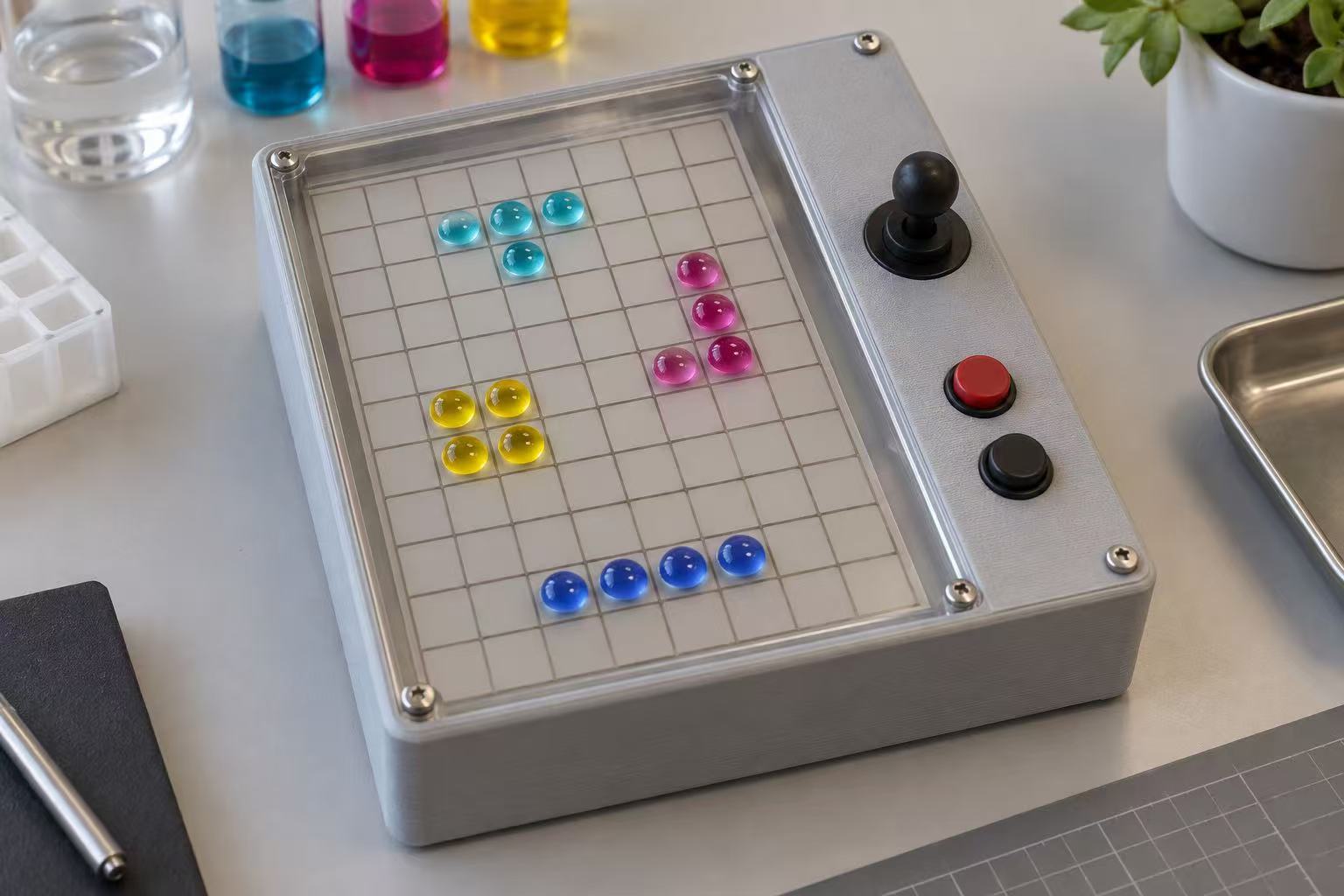
If Tetris can be as big as a building, could it fit inside a tiny board?
This idea started with Microfluidic Bubble Logic by Manu Prakash and Neil Gershenfeld. I was fascinated by the idea that moving bubbles could carry information and perform logic operations.
While thinking about microfluidics, I remembered the giant Tetris game on MIT's Green Building. That led me to digital microfluidics, which offers a way to control individual droplets electronically. I want to explore what happens when the pixels in a game are made of liquid.
I want to build a small physical display using digital microfluidics (DMF), with colored droplets as its moving pixels.
My eventual goal is a playable, Tetris-inspired game controlled by buttons or a joystick. The board will use electrowetting on dielectric (EWOD). It is a technology that uses an electrical voltage to change a surface from water-hating to water-loving.
Activating neighboring electrodes in sequence will guide a droplet across the board. The board will lie horizontally, so a piece's “falling” motion will be a programmed sequence of moves toward the bottom of the grid. MIT's Programmable Droplets project is a useful reference for this approach.
Eventually, I would like to coordinate several droplets into game pieces and explore merging and row clearing. Clearing a row will require somewhere for the liquid to go, such as a collection area. For the first prototype, I will focus on reliable movement.
The milestones follow the 2026 HTMAA syllabus. They are a starting point and may change after the first droplet tests.
Develop the proposal, sketch the board in Fusion 360, and cut prototype spacers or gaskets.
Prototype the grid-based game logic and electrode-control sequences.
Print a small holder for the test board and controls.
Design and fabricate a 3 × 3 electrode array and its control electronics. Begin testing dielectric and hydrophobic surface layers.
Add buttons or a joystick for manual droplet control.
Integrate the high-voltage driver and demonstrate repeatable droplet movement.
Refine the surface treatment and enclosure seals, and review whether scaling up is practical.
Connect the game logic to the board and add a simple interface for testing.
Assemble, test, and document the prototype. Finalize additional orders by Dec 4 and prepare for the Dec 15 presentation.
Build a 3 × 3 array and test whether one droplet moves between neighboring electrodes, including downward and sideways moves. Use the result to choose the electrode geometry and surface materials.
Add physical controls and a simple falling-droplet game. Aim for at least 18 successful moves out of 20 commanded one-cell moves, without manually repositioning the droplet.
Use a parametric Fusion 360 layout to explore an 8 × 12 board. Then redesign the routing and driver capacity, test coordinated droplets, and explore a way to clear or reset the board.
A small board on which a player can reliably steer a real droplet.
| Item | Quantity | Likely source |
|---|---|---|
| XIAO RP2040 or ESP32 controller | 1 | Fab inventory |
| Electrode PCB and test boards | 2–3 boards | Fab inventory |
| Buttons, connectors, passive components, and logic-level interfacing | 1 set | Fab inventory |
| Printed enclosure, spacers, and adhesive | 1 set | Fab inventory |
| High-voltage electrode driver | 1 | Likely additional purchase |
| Suitable high-voltage supply and supporting power parts | 1 set | Likely additional purchase |
| Dielectric films and hydrophobic surface materials | Samples / roll | Likely additional purchase |
| Silicone oil, dye, and liquid-handling supplies | Small amounts | Likely additional purchase |
Wedyan Babatain used electromagnets to move magnetic liquid-metal droplets. The project is a reference for building a droplet-control platform, although its actuation method differs from EWOD.
See the project ↗Steve Mould demonstrated how moving water droplets can become an interactive game. It is especially close to the experience I want to create.
See the demonstration ↗MIT explored EWOD for displays, play, and other interfaces through droplet movement, merging, splitting, and shape changes. The related DropletIO project investigates integrated actuation and sensing.
See the research ↗