Research & Literature Review
Physical neural networks (PNNs) do not assign every neural-network operation to a digital processor. Instead, a physical system—light, an electronic circuit, a mechanical structure, sound, or material dynamics—performs part or all of the computation.
Interesting finding: early neural networks were physical machines. They later became mathematical models running on computers; recent research is again asking whether the physical world itself can carry out neural computation.
Physical NN: four directions
A. Optical / Photonic Neural Networks
- Main mechanisms: light propagation, interference, diffraction, phase modulation, and optoelectronic conversion.
- Light can implement transformations in parallel, but practical systems still need to solve nonlinearity, calibration, and integration with electronics.

Image: silicon photonic neural-network chip.
B. Electronic / Analog Neural Networks
- Main mechanisms: voltage, current, transistors, analog integration, device conductance, and circuit feedback.
- Inputs can be voltages, weights can be set by potentiometers or conductances, and an analog summing circuit can produce the weighted sum directly.

Image: Lu.i educational neuron PCB.
C. Mechanical Neural Networks
- Main mechanisms: elastic deformation, force transmission, geometric nonlinearity, mechanical coupling, and vibration.
- Here, a connection’s stiffness, lever arm, or geometry can be a parameter; forces and displacements become the signals.
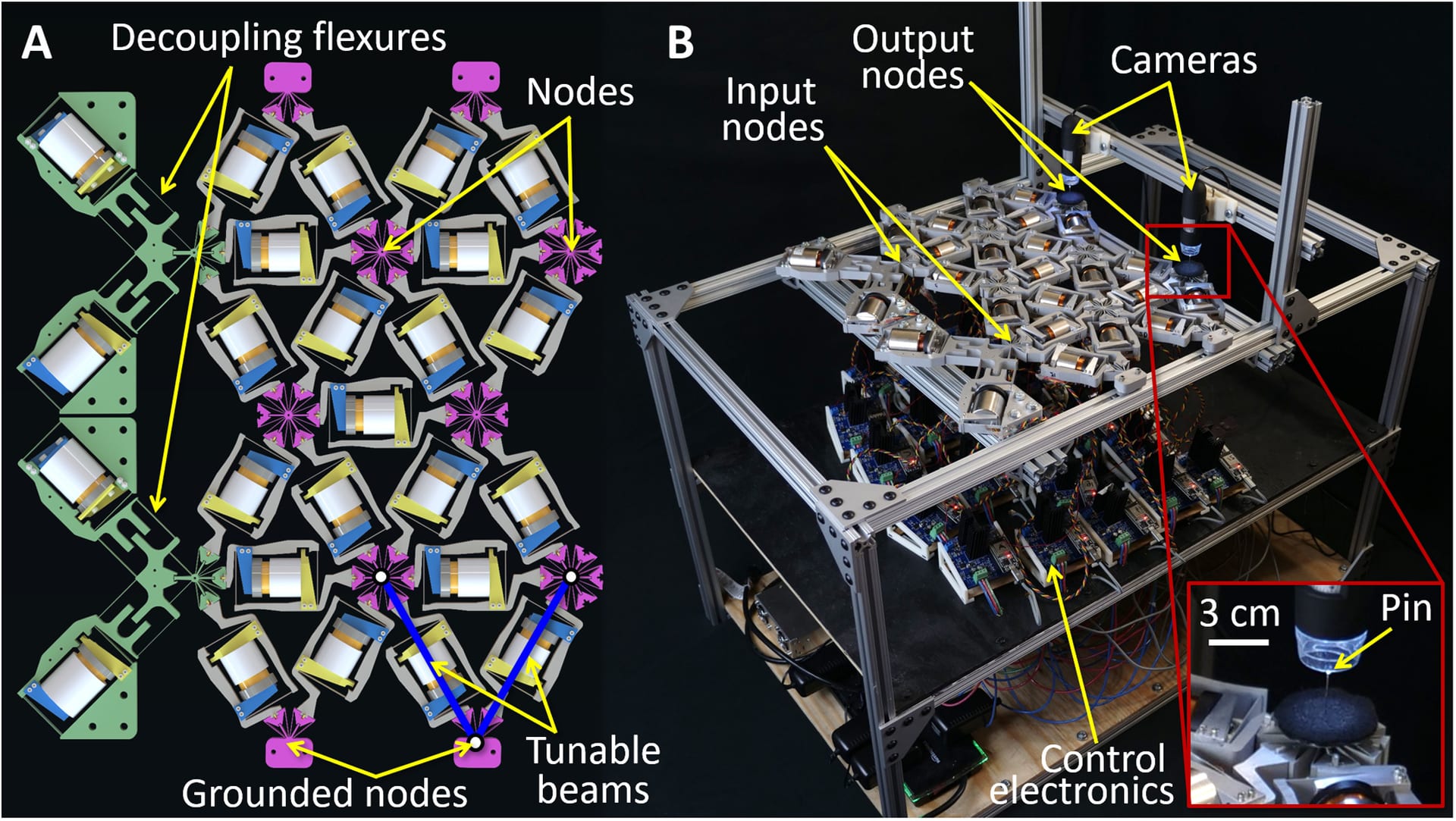
Image: Axel Schaffland, Mechanical Neural Network.
E. Soft, Fluidic, and Other Continuous-Medium Computing
- Main mechanisms: continuous-medium dynamics, flow, diffusion, deformation, and multiphysics coupling.
- These systems are especially interesting for soft robotics because sensing, logic, and actuation can share one material system.
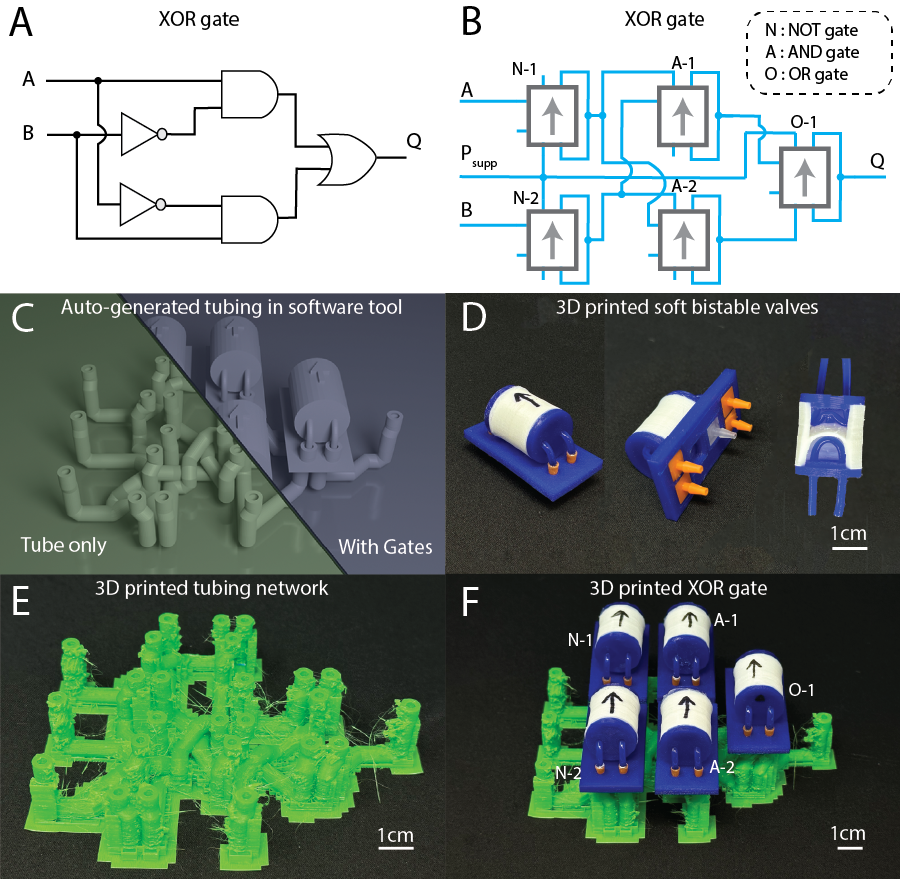
Image: STREAM: 3D-printed fluidic circuits.
Literature review
- Training of Physical Neural Networks — Nature (2025)
A field-level review of how physical systems can be trained, not just used for fixed inference.
Possibility 1: Mechanical NNs
-
Training All-Mechanical Neural Networks for Task Learning Through In Situ Backpropagation — Nature Communications (2024)
Shows how mechanical networks can obtain gradient information locally for task learning. -
Mechanical Neural Networks: Architected Materials That Learn Behaviors — Science Robotics (2022)
A key example of mechanically programmable structures learning target responses. -
Mechanical neural-network overview video
A short visual entry point for the mechanical approach. -
Axel Schaffland: Mechanical Neural Network (2022)
A 2–4–2 multilayer perceptron made from wooden levers, strings, pulleys, and movable clamps. It demonstrates ReLU, function fitting, and XOR as an educational, hands-on machine. -
Project documentation: Mechanical Neural Network · demonstration video
The most directly useful reference for a tangible mechanical reconstruction.
Possibility 2: Electronic / Analog NNs
-
Mark I Perceptron — Smithsonian National Museum of American History
A historical anchor: early neural networks were built as physical electronic machines, not only as software. -
Welch Labs: perceptron video · analog perceptron demonstration
Useful visual references for a compact, educational analog implementation. -
rdb64 Analog Perceptron — GitHub
A practical open-source route with circuit schematics, PCB and Gerber files, a bill of materials, a build guide, and 3D-printable frame files.- Input switches produce electrical input signals.
- Potentiometers set the weights.
- Analog circuits calculate the weighted sum.
- An analog meter makes the output visible.
-
Lu.i Educational Neuron PCB
A fully analog leaky-integrate-and-fire neuron with visible membrane potential, tunable excitatory/inhibitory synapses, and patchable connections between boards. -
Lu.i educational-neuron paper — Trends in Neuroscience and Education (2025)
Documents the educational use of the circuit and its open hardware approach.
Project constraint
The core requirement: no software in the computation. Inputs, weights, weighted sums, activation, and output should occur in the physical system itself—not in an Arduino, microcontroller, or program.
Perceptron V1
I designed the first version of my physical perceptron.
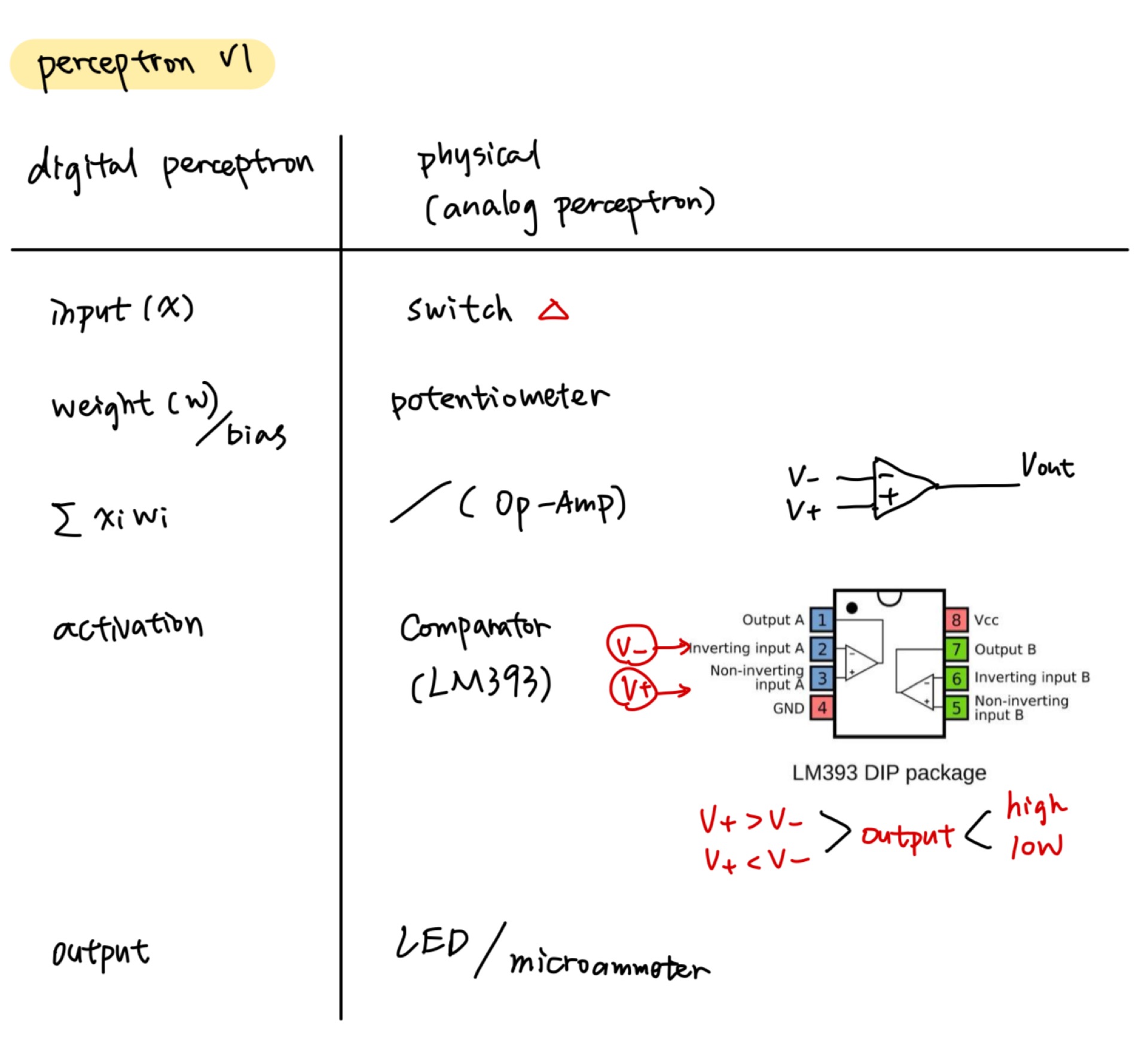
Mapping a digital perceptron to physical controls and signals.
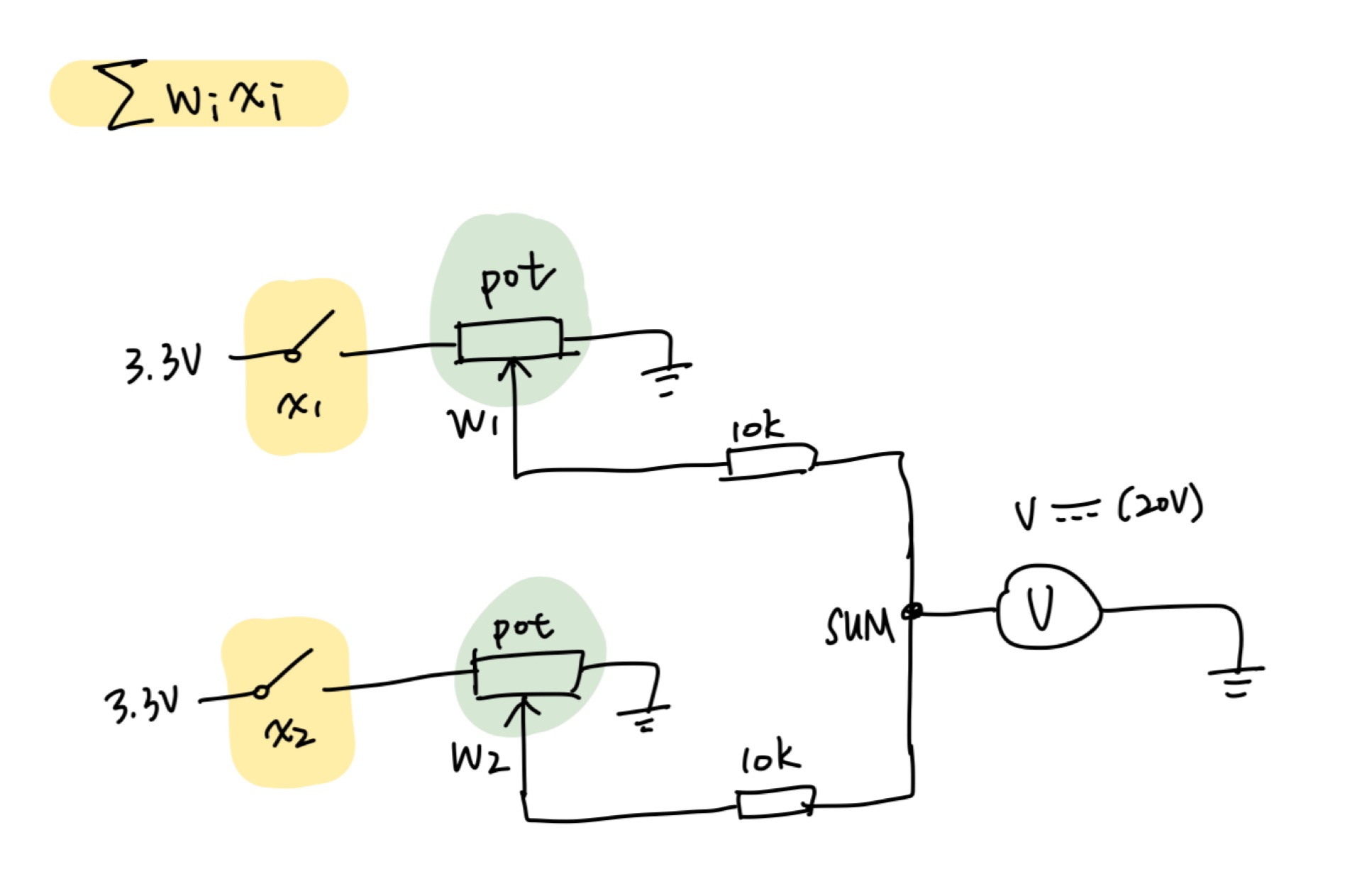
Achieving weighted sum with switches and potentiometers.
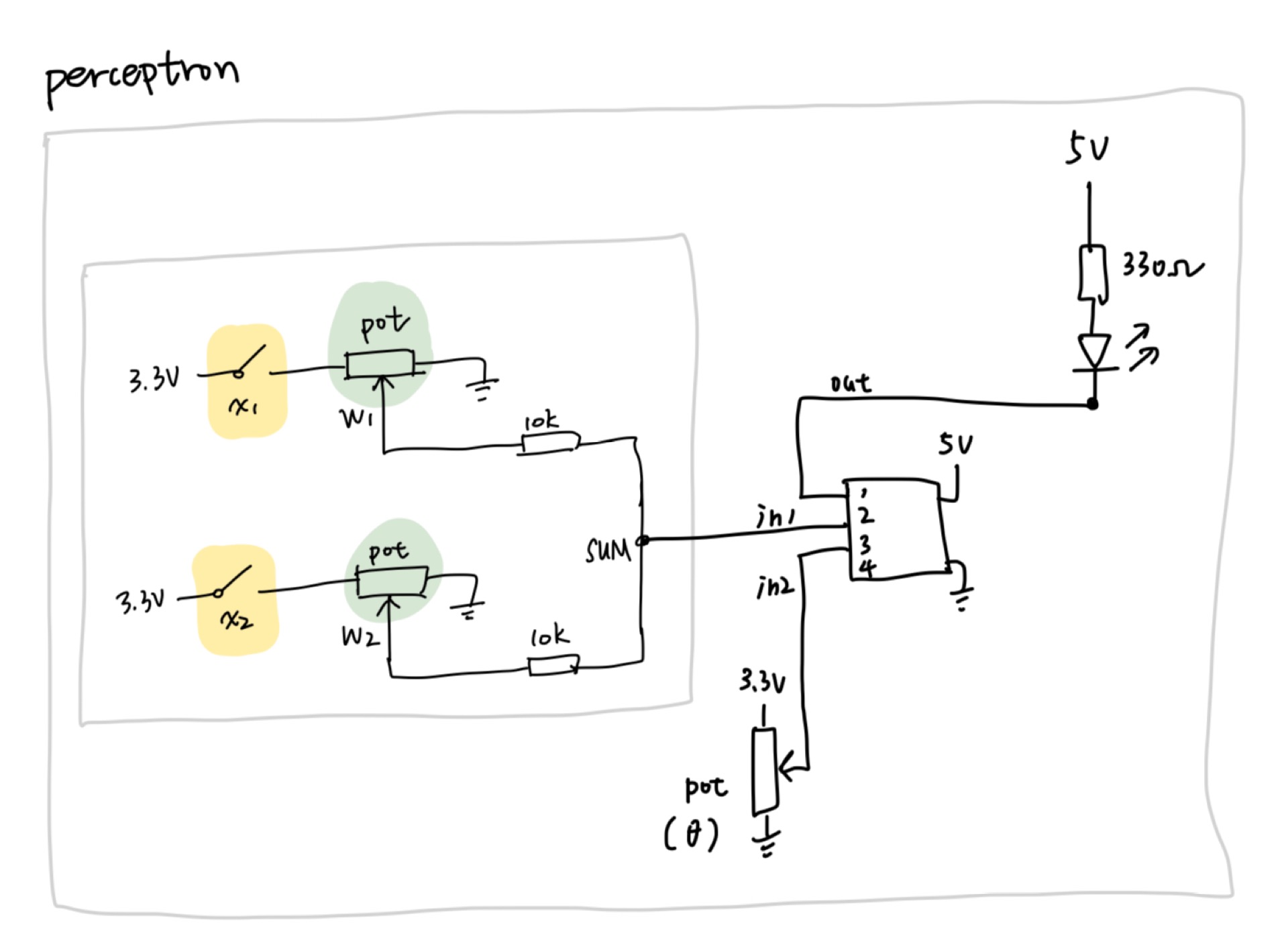
Adding a threshold comparator and LED to make a full perceptron.
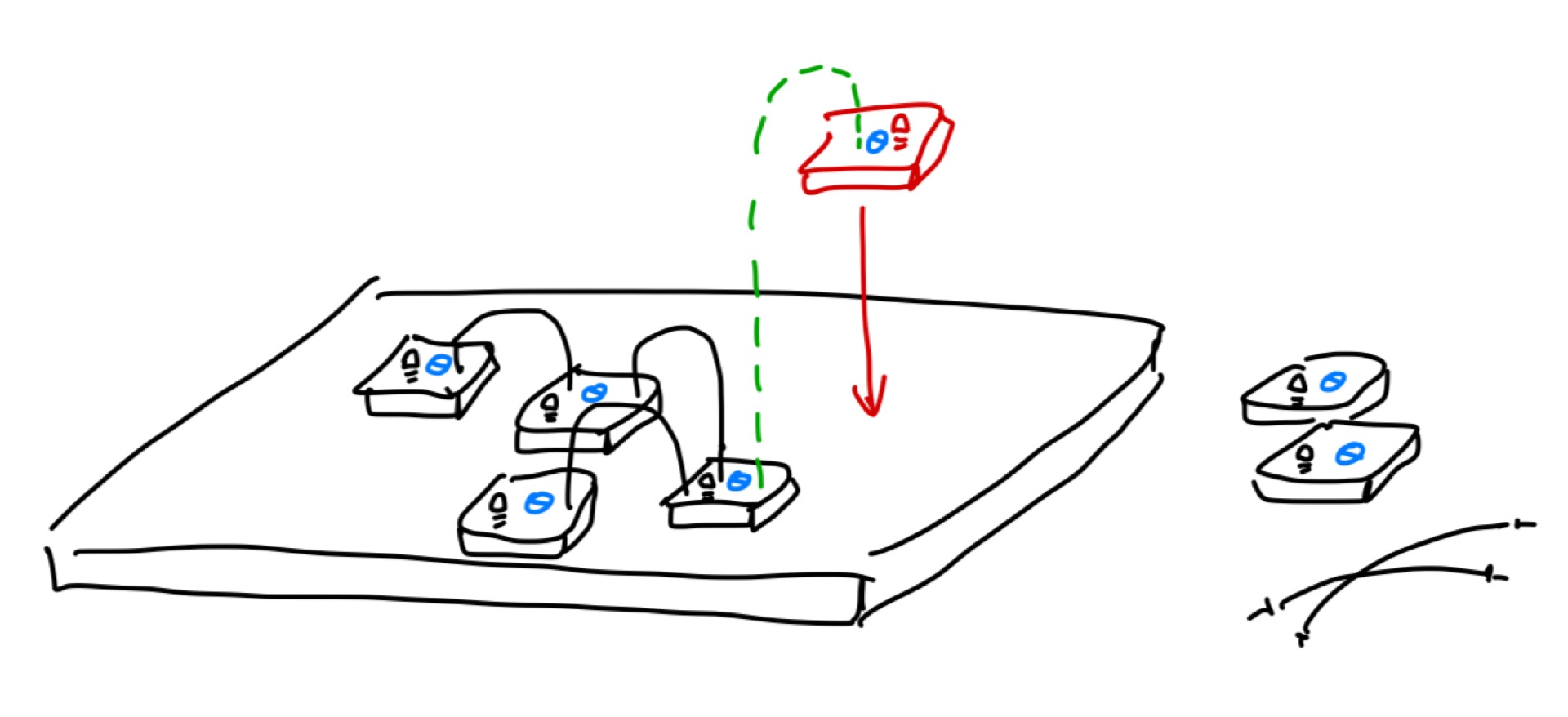
An early sketch for arranging the circuit as a hands-on object.