Final Project
October 20
I'm creating a tabletop art installation for my HTMAA final project. The idea is that electronic cubes are stationed on top of a tabletop board. There are motorized magnets inside each of the small cubes as well as within the board. Upon input, the magnets within the board will move the small cubes into place, and then the small cubes will self-assemble into different configurations in 3D by internally shifting their magnets to pivot and move against each other. The goal is to produce simple pieces of 3D art, like the above text.
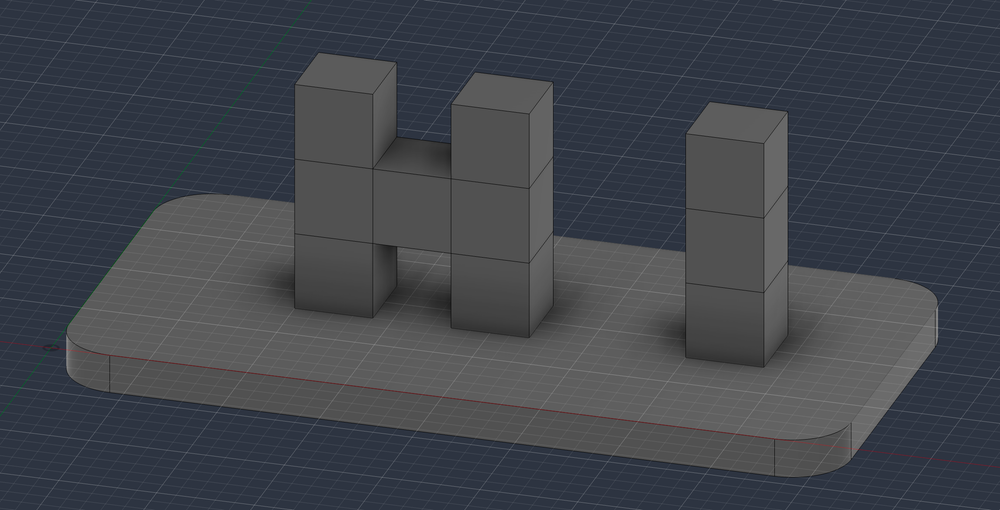
I'm envisioning several milestones for this.
- Demonstrate two cubes, when positioned side by side, magnetically pivoting against each other to stack.
- Stacking multiple cubes into the "HI" shape from a preconfigured position.
- Building the electronics inside the tabletop, where mobile magnets move the cubes.
- Building a conversion path from the desired 2D or 3D visual into a sequence of abstractions for magnet movements, which are then converted into a precise sequence on the microcontroller. In other words, given a 3D display for the final product, can we move the cubes into that position?
- Using visual input: if we see an object using a camera, can we recreate it on the tabletop display to as high a fidelity as possible?
(Some of these are stretch goals, I think getting 1-3 will already be very hard and I'd be happy if I could make that happen.)
There a few core challenges I'm envisioning:
- How can we get enough torque such that one cube can climb another cube without the base cube shifting? We can use the table as a constructed support, holding the base of the first magnet firm whilst the second magnet climbs. We can also use internal motors in each cube to climb, whereas the magnets mainly connect at joints so the climbing cube doesn't slip.
- How can we make sure that all of these electronics (actuators, motors, microcontrollers, circuitry, magnets, etc.) fit into a small enough magnet?
Some research on related work: