

Week 00A
Final Project Proposal
.jpg)
TLDR
I want to build a modular reconfigurable robot: a set of identical, magnetically connected modules, each with one servo-driven rotating joint and a XIAO ESP32-S3, that can fold, stack, and reshape into different structures.
Modular Reconfigurable Robotics
What It Is
A modular reconfigurable robot is built from many simple units instead of one fixed body. Each module has its own actuator and connects to its neighbors, so the same set can change shape for different tasks: walking as legs, rolling as a loop, or standing as a tower. Because the modules are identical, the system can also repair itself by replacing a broken unit with another one.
Lattice, Chain, and Hybrid Systems
The field usually sorts these robots into three types:
Lattice: modules sit on a regular grid, like atoms in a crystal, and move from one grid position to the next. This makes reconfiguration simpler to plan. ATRON (University of Southern Denmark) is one example.
Chain: modules connect in strings or trees, and their joints can reach any point in space. Chains can walk, roll, and climb, but long chains are harder to control. PolyBot (Xerox PARC, Mark Yim) is a classic example: the G3 modules below dock end to end into a chain (photo: Mark Yim, Wikimedia Commons, CC BY 2.5).
.jpg)
Hybrid: modules combine both, snapping onto a lattice to reconfigure while still bending like a chain to move. M-TRAN (AIST), Roombots (EPFL), and SMORES (University of Pennsylvania) are hybrid systems.
Precedents
M-Blocks (MIT CSAIL): cubes with no external moving parts. A flywheel inside each cube spins up and brakes suddenly, so the cube flips onto its neighbors. Magnets on the edges and faces hold the cubes together (MIT News).
Roombots (EPFL): modules with three rotating joints that combine into furniture-like objects and can move around a room.
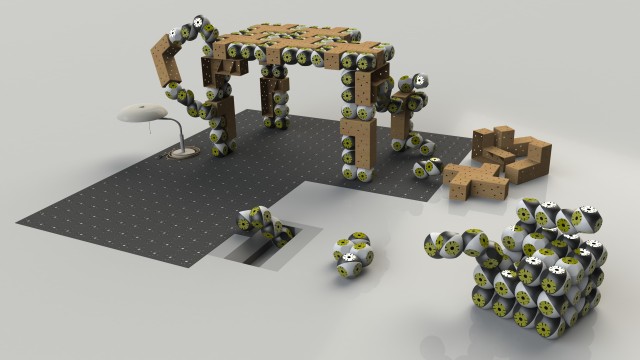
CuGo (Interactive Architecture Lab, Bartlett): modular robots by Peng Gao and Kongpyung Moon that cooperate with people to build and rearrange block structures. It first showed me how simple repeated parts can produce complex behavior.
.jpg)
Where My Project Fits
My module is closest to a hybrid system. Like Roombots, each module works as a rotating joint. Like M-Blocks, it connects with magnets instead of motorized latches, which keeps the module simple, cheap, and small enough to print. The trade-off is that magnets cannot release on their own, so for now some reconfiguration will happen by hand while the joints handle the motion.
Key Challenges
Research in this field points to the same problems I expect to face at a small scale:
- Connection: the joints between modules need to be strong enough to lift neighbors but easy to separate.
- Power and torque: each module carries its own motor, so the motor has to be small yet strong enough to move the modules attached to it.
- Communication and control: the modules need to coordinate their movement, which becomes harder as the number of modules grows.
- Wiring: power and signals have to pass through a joint that keeps rotating.
Concept
Starting Point
I am interested in objects that are not fixed to one form. Instead of designing a single shape, I want to design a unit that can be repeated, connected, and rearranged, so the form emerges from how the pieces are combined.
Module
Each rounded module is split into two halves that rotate against each other, with magnets on its faces to attach to its neighbors. Every module carries its own motor, so each one is a small joint in a larger body.
.jpg)
Reconfiguration
The same set of pieces can become a compact cluster, a tower, or something in between. The simulation shows how a group of modules could transform from one configuration to another.
.jpg)
Actuation
Inside each module, a motor drives a gear on a rotating plate, so one half of the module turns against the other. Chained together, these small rotations become the movement of the whole bot.
.jpg)
Plan
Components
- Body: 3D printed PLA modules with magnet pockets on their faces.
- Actuation: a micro servo motor in each module.
- Control: a Seeed Studio XIAO ESP32-S3 on a custom milled PCB; its Wi-Fi and Bluetooth allow communication between modules.
- Connection: neodymium magnets embedded in the faces.
Milestones
I will use the weekly assignments to build the project step by step:
- Modules (Week 03): print the module bodies and test the magnetic connections.
- Electronics (Week 04 onward): design and mill a board that drives the servos.
- Sensing (Input Devices): detect when a module touches or connects to a neighbor.
- Motion (Output Devices): turn the servo rotation into the joint motion of each module.
- Coordination (Networking): let modules send commands to each other so they move together.
- Integration (System Integration): fit the board, motor, wiring, and magnets inside each module.
Progress
I log the progress of the project week by week on the Final Project Tracking page.